
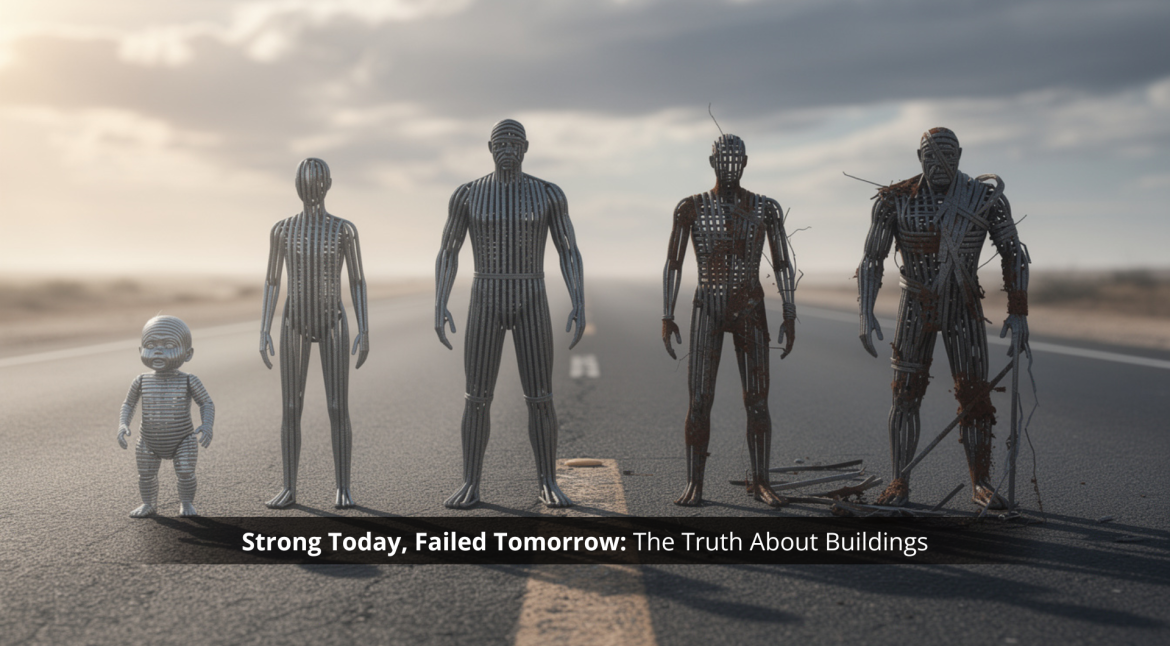
Most Buildings Don’t Fail Because They’re Weak – They Fail Because They Age Badly
Here’s something no one puts in project presentations.
Buildings rarely fail on Day 1.
They fail quietly… over time.
Everything looks perfect when a structure is handed over – clean finish, solid framework, zero
visible flaws. But fast forward a few years, and you start noticing the signs: hairline cracks,
rust stains, patches of damage that weren’t part of the original plan.
So what changed?
Not the design. Not the load.
The material started losing its integrity.
And at the center of that slow failure is one overlooked factor: corrosion in steel.
Time doesn’t break structures. Exposure does.
Two identical buildings can be built the same way, in the same year.
Ten years later, one needs repairs. The other doesn’t.
The difference is hidden inside the steel.
Corrosion Isn’t Damage. It’s a Slow Downgrade of Strength
Let’s clear a common misconception – corrosion isn’t just rust sitting on the surface. It’s a
chemical process that actively reduces the strength of steel.
When moisture and oxygen reach steel (which they always do, thanks to concrete porosity), a
reaction begins. Rust forms. But rust doesn’t just sit there – it expands. And that expansion
creates internal stress inside the concrete.
Now imagine this happening silently for years.
And the most dangerous part? This damage stays invisible until it’s irreversible.
Steel bars become thinner.
Concrete starts cracking.
Load-bearing capacity drops without warning.
That’s why corrosion-resistant steel isn’t about preventing rust completely – it’s about
slowing down structural decay.
Why Today’s Structures Are at Higher Risk Than Ever
Modern construction isn’t just about strength anymore it’s about survival in harsher
conditions.
Construction today isn’t happening in ideal conditions – it’s happening in aggressive environments.
Urban air carries pollutants. Coastal regions bring salt-loaded moisture. Even normal weather cycles create repeated expansion and contraction inside concrete. All of this accelerates corrosion.
So steel isn’t just doing one job anymore. It’s not just carrying load – it’s constantly defending itself.
And if you’re using standard reinforcement steel in these conditions, you’re essentially sending it into a fight without armor.
That’s exactly why corrosion-resistant TMT bars are becoming critical in modern construction – not optional.
The Cost Nobody Calculates (But Everyone Pays Later)
The real cost of steel isn’t what you pay upfront it’s what you pay years later.
Here’s where most decisions go wrong.
Regular steel looks cheaper on paper. And in the short term, it is. But corrosion doesn’t show
up immediately – it shows up when it’s expensive to fix.
Repairs involve:
● Breaking concrete
● Replacing damaged steel
● Rebuilding structural sections
And none of this is cheap or quick.
So what seemed like cost-saving at the start becomes a long-term liability.
Smart builders don’t just compare prices per ton of steel.
They compare cost per year of performance.
What Actually Makes Steel Corrosion-Resistant
Not all steel behaves the same over time. The difference lies in how it’s made.
Corrosion-resistant steel is engineered using:
● Controlled chemical composition (adding elements like copper, chromium)
● Advanced processes like Thermo Mechanically Treated (TMT) technology
● Improved microstructure that slows oxidation
This combination helps steel resist moisture penetration and reduces the rate of rust
formation.
In simple terms:
Regular steel reacts faster.
Corrosion-resistant steel reacts slower – and that time gap is everything.
Because Longevity Is the Real Benchmark
In construction, lifespan is the only metric that truly compounds.
No one builds for 5 years. Every structure is expected to last decades.
So the real question isn’t:
“Is this steel strong enough today?”
It’s:
“Will this steel still perform 20–30 years from now?”
Because strength is immediate.
But durability – driven by corrosion resistance – is what defines lifespan.
Final Thought
Concrete shapes a building.
Steel supports it.
But corrosion resistance decides whether it ages like concrete… or crumbles like dust.
06-04-2026 article
And that decision?
It’s made on Day 1 – when you choose the steel.